The Hermit — tarot card meaning
Deliberate solitude, holding a lamp for one person: you.
Upright
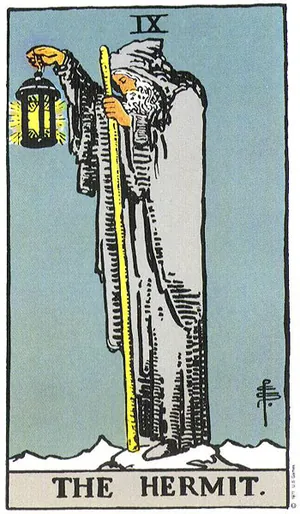
An old man stands on a mountain peak holding a lantern with a six-pointed star inside, leaning on a staff. He has already climbed; there is nobody else up there. This card is not loneliness, it is chosen withdrawal — the period where you stop asking everyone and go look for the answer yourself. It legitimises taking time out to think, study or recover, and warns that advice gathered from a crowd will not survive contact with your actual situation.
Reversed
Reversed, the withdrawal has stopped being a choice. Isolation that no longer restores anything, or the opposite: never alone long enough to hear yourself. Sometimes it is refusal to come back down with what you learned. The lamp is meant to be carried back to other people eventually.
Love
Space is the honest answer here. Either you need it, or you need to stop giving it.
Career
Work alone and go deep. This is a period for craft, not for visibility.
Mood
Withdrawn, reflective, self-contained.
Spiritually
The answer is not in more input. Turn the lamp inward.
What the card shows
A cloaked old man stands alone on a snowy peak, staff in one hand, a lantern holding a six-pointed star in the other.
Upright keywords
- introspection
- solitude
- inner guidance
- wisdom
- searching
Reversed keywords
- isolation
- loneliness
- withdrawal
- lost direction
- avoidance
Common questions
Does The Hermit mean I should isolate myself?
It means the answer will come from time spent with your own thinking, not from more opinions. That might be an evening, or a season. The reversed position is the check: if the solitude has stopped giving anything back, it has become avoidance.
How is The Hermit read differently when reversed?
Reversed does not flip the meaning. It usually shows the same theme blocked, internalised, overdone or delayed — the energy is present but not moving in a useful direction.
Does The Hermit have a fixed position in a spread?
No. In Rider-Waite reading the card takes its meaning from its position — past, obstacle, advice and so on all change what it is saying. The card describes a quality; the position tells you where it is operating.
Tarot is a reflective tool, not a prediction service. Nothing here is medical, legal or financial advice, and no reading — simulated or otherwise — can tell you what another person will do. Card artwork: Rider-Waite-Smith (1909), public domain.
Card meanings follow the Rider-Waite-Smith tradition. Artwork is public domain (Pamela Colman Smith, 1909). Interpretations are ours, written for reflection, not prediction.